Your Microsoft 365 Bill Is About to Go Up: What Small Business Owners Need to Know Before July 1

Microsoft 365 prices are rising July 1, 2026 — a planning moment for every small business owner.
A briefing for owners, operators, and finance leaders of small and mid-sized businesses
If you run a small business and Microsoft 365 sits at the heart of your operation — your email, your Word and Excel, your Teams meetings, your SharePoint files — there's a number on your next renewal that's about to change. On December 4, 2025, Microsoft quietly announced the first across-the-board price increase on commercial Microsoft 365 plans in years. Those new prices take effect July 1, 2026, and your monthly bill is going up between 12% and 23% depending on which plan you're on.
Here's what's changing, what it means for your budget, and what to do about it before your next renewal.
The Short Version
If you're on the most common small-business plans, here's what happens July 1:
PlanWhat it includesOld PriceNew PriceIncrease
Microsoft 365 Business Basic
Web/mobile Office + email + Teams$6.00/user/mo$7.00/user/mo+16%Microsoft 365 Business Standard
Desktop Office + email + Teams$12.50/user/mo$14.00/user/mo+12%Microsoft 365 Business Premium
Standard + advanced security & device management$22.00/user/mo$22.00/user/moNo change
And if you're on a "no Teams" variant (the version Microsoft was forced to unbundle in Europe and made available globally):
PlanOld PriceNew PriceIncreaseBusiness
Basic (no Teams)$4.40$5.40+23%Business Standard (no Teams)$9.29$10.79+16%Business Premium (no Teams)$18.79$18.79No change
Standalone components are going up too.
If you license Microsoft 365 Apps (just the desktop apps, no email), you're looking at a 17% jump from $12 to $14 per user per month. Apps for Business is up 21%.
What This Actually Costs You
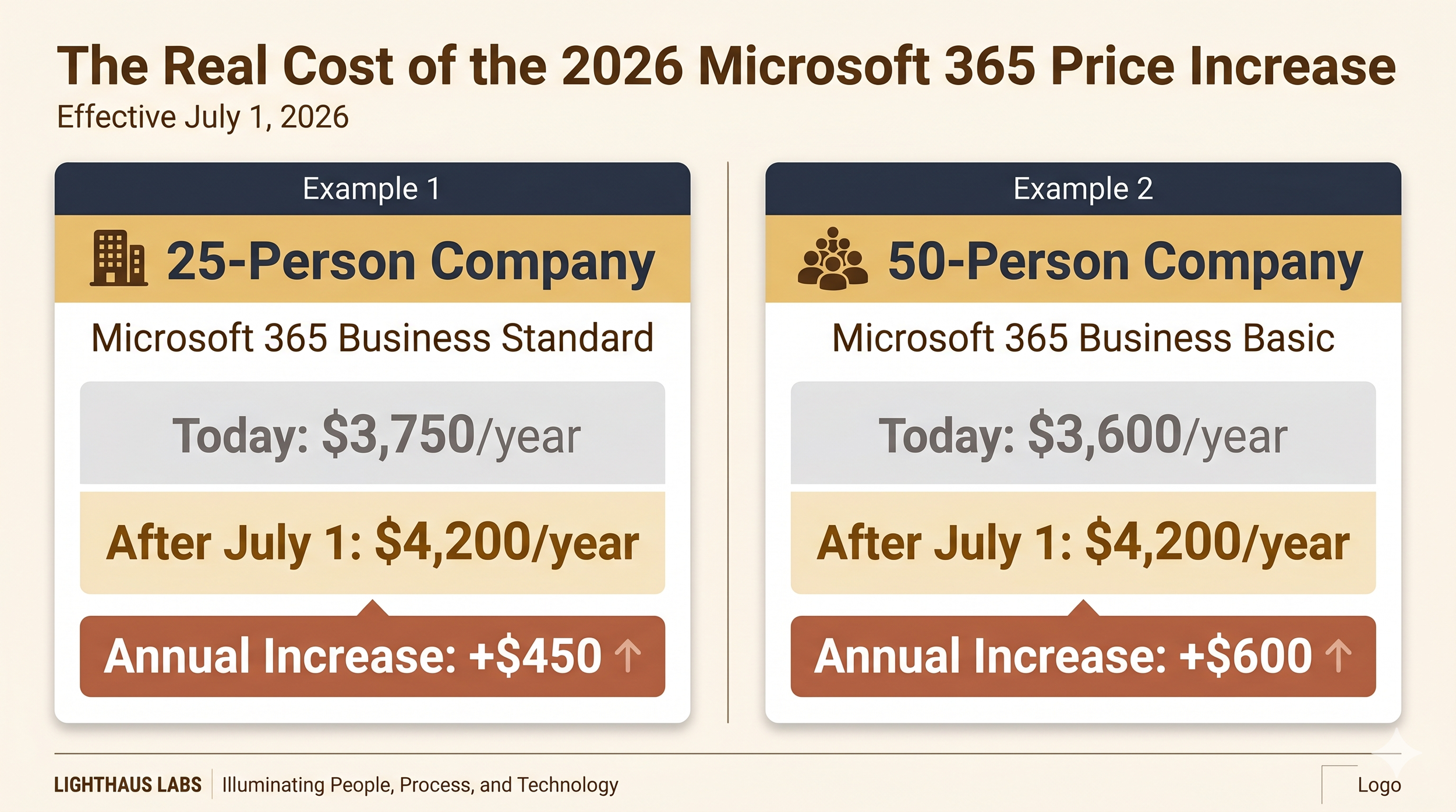
Let's put real numbers on it. A 25-person company on Business Standard:
Today: 25 × $12.50 × 12 = $3,750/year
After July 1: 25 × $14.00 × 12 = $4,200/year
Annual increase:$450
A 50-person company on Business Basic:
Today: 50 × $6.00 × 12 = $3,600/year
After July 1: 50 × $7.00 × 12 = $4,200/year
Annual increase:$600
Not catastrophic in isolation. But this is on top of insurance increases, payroll increases, and likely your other SaaS vendors quietly doing the same thing. It adds up.
Why Microsoft Says This Is Happening
Microsoft is positioning these increases as a value exchange. Alongside the new pricing, they're adding capabilities to each plan starting in June 2026:
Business Basic and Standard get an additional 50GB of email storage per mailbox, URL time-of-click protection (a phishing defense that re-checks links the moment a user clicks them), and Copilot Chat enhancements with access to Word, Excel, and PowerPoint agents.
Business Premium gets the email storage bump and the Copilot Chat enhancements.
All plans get Copilot Chat Analytics so admins can see how AI is being used.
The Copilot additions are real — and if you've been considering Microsoft 365 Copilot (the $30/user/month add-on) but balking at the price, these baked-in capabilities are a meaningful step toward AI in your everyday workflow without paying for the full Copilot license.
That said: most small businesses don't bump up against mailbox storage limits or actively use Copilot Chat features today. Whether the added capabilities justify the increase depends entirely on whether you'll actually use them. Pay attention to whether your team adopts the new features — if not, you're paying more for the same thing.
What Happens to Your Current Subscription
Three important things to understand about the timing:
You stay on current pricing until renewal. If you're mid-term on an annual commitment, your price doesn't change until you renew. Microsoft is honoring the term you signed for.
Any renewal on or after July 1, 2026 hits the new pricing. Even if your renewal is automatic, it will renew at the new rate.
Monthly subscriptions adjust at the next billing cycle on or after July 1. If you pay month-to-month, you'll see the change quickly.
If your renewal lands in July, August, or September of 2026, you're in the first wave. Don't be surprised.
What Smart Small Business Owners Should Do Right Now
This isn't a crisis — but it is a moment that rewards preparation. Five things to put on your calendar in the next 30 days:
1. Know your renewal date. Open your Microsoft 365 admin portal (or call your IT provider / Pax8 partner / CSP) and find out exactly when each of your subscriptions renews. If you don't know this, you can't plan around it.
2. Right-size your licenses. Most small businesses overpay for Microsoft 365 because they're not tracking who actually uses what. Run a license audit:
Are you paying for users who left the company?
Are some employees on Business Premium when Business Standard would suffice — or vice versa?
Are external contractors taking up paid seats when they could use a free Teams guest account?
Do you have orphaned subscriptions from old initiatives?
Even shaving 5–10% off seat count typically offsets the entire price increase.
3. Consider locking in an annual commitment before July 1. If you're currently on a month-to-month plan, switching to an annual commitment before July 1, 2026 locks in today's price for a full year. For a 25-person Business Standard shop, that's a $450 hedge for the cost of zero flexibility you're probably not using anyway.
4. Evaluate Business Premium more seriously. Here's the quietly interesting story: Business Premium is not going up while Business Standard is going up 12%. The price gap is narrowing. Business Premium includes Intune (device management), Defender for Business (endpoint protection), Entra ID P1 (identity protection), and Azure Information Protection — security tooling that would cost more to assemble piecemeal. For many SMBs that are growing or care about cybersecurity (and after Canvas, PowerSchool, and the SonicWall vulnerabilities, you should care), Business Premium may now be the better dollar-for-dollar choice. Re-run the math.
5. Don't forget the security and compliance angle. This is a good moment to revisit:
Vendor risk: Microsoft is one of your most critical vendors. Do you have multi-factor authentication enforced on every account? A documented backup strategy for your Microsoft 365 data (Microsoft does not back up your data the way most owners assume)?
Business continuity: What's your plan if your tenant gets compromised or locked out? If you don't have one, that's a bigger problem than a 12% price increase.
Cyber liability insurance: Most carriers now require MFA, endpoint detection, and documented incident response. Business Premium's bundled security features may help you check those boxes.
The Bigger Picture
Microsoft 365 price increases are not a one-time event — they're now part of the landscape. Google Workspace did the same thing. Your CRM, your accounting software, your payroll provider, and your cybersecurity tools will all do the same thing on their own schedules. The era of flat-priced SaaS is over.
For small business owners, this means software costs need a recurring line in your annual budgeting review, not a one-time setup decision. Build in 5–10% annual inflation on every cloud subscription you have. Audit usage at least once a year. Renegotiate or right-size before every renewal, not after.
Your Next Move
The single highest-leverage action this week: find out when each of your Microsoft 365 subscriptions renews, and put a 60-day-prior reminder on your calendar to review usage and options. That one habit will save you more money over time than any single negotiation.
At Lighthaus Labs, we help small and mid-sized businesses make sense of their technology spend, right-size their Microsoft 365 licensing, and bake security into the renewal conversation rather than treating it as a separate (and scarier) line item. If your renewal is coming up in the next 6 months — or if you haven't done a license audit in over a year — that's a 30-minute conversation worth having now.
📞 312-656-5558 📧 hello@lighthauslabs.com
Illuminating People, Process, and Technology.
Sources: Microsoft 365 Pricing and Packaging Updates, Microsoft Licensing News, February 16, 2026; Pax8 Partner Pricing Alert, 2026.