When the Classroom Goes Dark: What the Canvas Breach Means for Your School
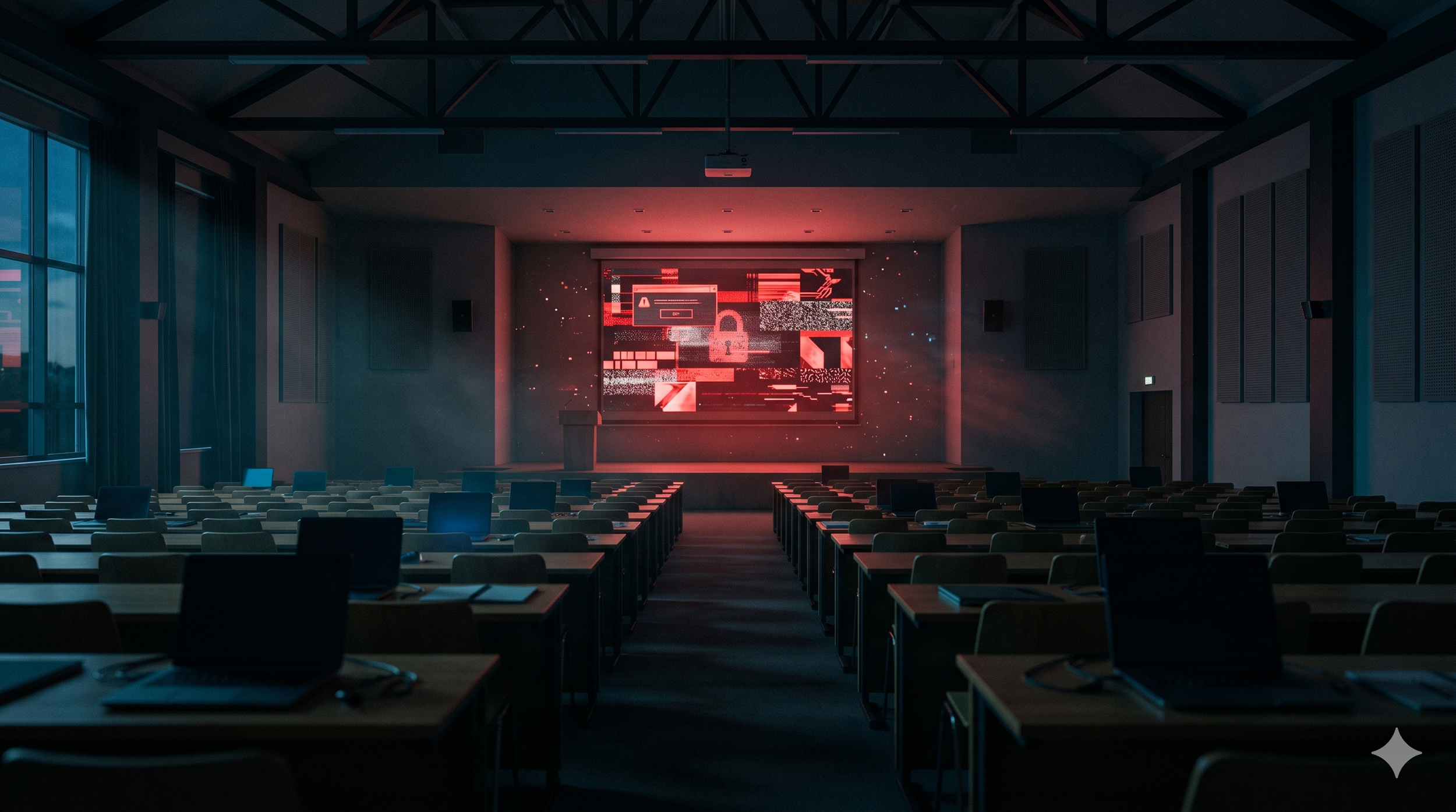
When Canvas went offline during finals week, thousands of classrooms looked just like this — empty, silent, and locked out of the systems students depend on.
A message for superintendents, college presidents, school boards, and trustees
On Thursday, May 7, 2026, tens of millions of students logged into Canvas during the worst week of the academic calendar — finals week — and were greeted not by their study materials, but by a ransom note. The hacking group ShinyHunters had breached Instructure, the company behind Canvas, for the second time in a week. By the time the smoke cleared, an estimated 9,000 institutions worldwide had been affected, with billions of private messages and student records reportedly accessed.
Canvas serves more than 30 million students across 8,000+ institutions, from K-12 districts in North Carolina, California, Tennessee, and Utah to flagship universities like Harvard, Princeton, Columbia, Rutgers, Georgetown, and the University of Oklahoma. When Canvas went down, finals didn't pause. Students panicked. Faculty scrambled. The University of Texas at San Antonio pushed back exams. Professors had to ferry course materials through email and personal websites. And somewhere in the chaos, sensitive student data — names, email addresses, ID numbers, private messages — walked out the door.
If you're on a school board, a board of trustees, or in a superintendent's office right now, here is the uncomfortable question you need to answer this week: If this had happened to us, what would we have done?
If you don't have a confident, documented answer, this post is for you.
This Wasn't an Anomaly — It Was a Pattern
The Canvas incident isn't an isolated bad day. It's part of a clear and accelerating trend:
PowerSchool — the K-12 learning management leader — was breached in a strikingly similar attack.
Minneapolis Public Schools and Los Angeles Unified School District have both suffered major incidents.
The same ShinyHunters group has been tied to attacks on Ticketmaster and other large consumer platforms.
Schools have become prime targets because they sit on a goldmine of digitized data — grades, IEPs, FERPA-protected records, financial aid information, health files, behavioral records, and family contact information — and historically have invested less in cybersecurity than banks or hospitals. Threat actors know this. They are not going to stop.
And here's the part that should keep every administrator awake at night: the breach wasn't of your network. It was of your vendor's network. You did everything right and still ended up in the headlines. This is third-party risk, and most institutions are profoundly underprepared for it.
The Four Documents That Would Have Saved You
When the Canvas note appeared on student screens, institutions split into two groups: the ones with plans, and the ones improvising on a Thursday afternoon in May. The difference between those two groups isn't budget. It isn't size. It's preparation. Specifically, these four artifacts:
1. IT Vendor Risk Assessment. When was the last time you formally evaluated Instructure's — or any of your major vendors' — security posture? Do you have their SOC 2 Type II report? Do you know their incident notification SLAs? Their data residency? Their subprocessors? If a board member asked you tomorrow, "Which of our vendors holds the most sensitive student data, and what is their breach history?" — could you answer in under five minutes?
2. Business Impact Analysis (BIA). A BIA tells you, in dollars and hours, what each system is worth to your operation. If Canvas (or your SIS, or your email, or your single-sign-on provider) goes dark for 4 hours, 24 hours, or 5 days, what breaks? Which functions are tolerable to lose, and which ones cripple instruction, compliance, or revenue? Without a BIA, every outage becomes a crisis because nobody has pre-decided what matters most.
3. Business Continuity & Disaster Recovery (BCDR) Plan. This is your "what we do when the lights go out" playbook. For Canvas specifically: Where do faculty post materials if the LMS is unreachable for a week? How do students submit assignments? How are finals administered? Who has authority to extend deadlines district-wide or campus-wide? If your answer is "we'd figure it out" — that's not a plan, that's a prayer.
4. Incident Response (IR) Plan. This governs the first 72 hours. Who calls whom? Who talks to the press? Who notifies parents, students, and regulators? At what point do you engage outside legal counsel, your cyber insurance carrier, and law enforcement? FERPA, state breach notification laws, and (for some institutions) GLBA all have hard deadlines that start ticking the moment you know.
Don't stop at four. Also look hard at:
Cyber liability insurance — review your coverage, your sublimits, and what your carrier requires you to have in place to avoid a claim denial.
Crisis communications plan — pre-drafted templates for parents, students, faculty, media, and your board, so you're not writing prose at 2 a.m.
Tabletop exercises — when did you last walk leadership through a simulated incident? If the answer is "never," that's the most important meeting you'll schedule this quarter.
Data inventory and classification — you cannot protect what you cannot find.
Acceptable use and vendor onboarding policies — how does a new SaaS tool get approved and contracted in your environment? In most schools, it's still a faculty member with a credit card and a click-through agreement.
What the Board Should Be Asking Monday Morning
If you serve on a board or board of trustees, you don't need to become a cybersecurity expert. You do need to ask the right questions and hold leadership accountable for documented answers. Here are six to start with:
Do we have a current IT Vendor Risk Assessment, and when was it last updated?
Have we completed a Business Impact Analysis that quantifies downtime cost by system?
Does our BCDR plan address scenarios where a critical SaaS vendor is unavailable for a week or more — not just our own network going down?
When was our Incident Response Plan last tested in a tabletop exercise involving board, leadership, IT, legal, and communications?
What is our cyber liability coverage, and what conditions must we meet for it to pay out?
Who, by name, is accountable for cyber risk at our institution — and do they report to the board on a recurring cadence?
If the answers are "we're not sure," "a few years ago," or "our IT director handles that," you have a governance gap, not just a technology gap.
The Reality of Cloud Dependency
A theme worth naming: schools are now profoundly cloud-dependent. Canvas, Google Workspace or Microsoft 365, your SIS, your finance system, your HR system, your video platform, your library databases — all SaaS, all hosted somewhere else, all with their own threat actors and their own bad days. The convenience and cost savings are real. So is the dependency.
This doesn't mean abandoning the cloud. It means treating every critical vendor like the operational dependency it has become: with formal due diligence, contractual security and notification requirements, documented contingency plans, and rehearsed response procedures. The same rigor you apply to your physical campus emergency plan — fire drills, lockdown drills, severe weather protocols — needs to apply to your digital one.
Your Next Move
The Canvas breach will fade from the headlines within a week. The vulnerability it exposed will not. Threat actors are watching to see which institutions take this as a wake-up call and which keep hitting snooze.
At Lighthaus Labs, we help schools, districts, and higher-education institutions translate incidents like this into action: vendor risk assessments, business impact analyses, BCDR and incident response plans, tabletop exercises, and the kind of board-level reporting that demonstrates due care to insurers, regulators, and your community.
If you're not certain you'd handle a Canvas-scale event better than the institutions in this week's headlines, let's talk. A 30-minute conversation now is a lot cheaper than a press conference later.
📞 312-656-5558 📧 hello@lighthauslabs.com
Illuminating People, Process, and Technology.
Sources:
CNN, "Canvas hack strands university students during finals week," May 7, 2026;