The AI Arms Race Reaches Main Street: What Business Owners, Parents, and Educators Need to Know Right Now
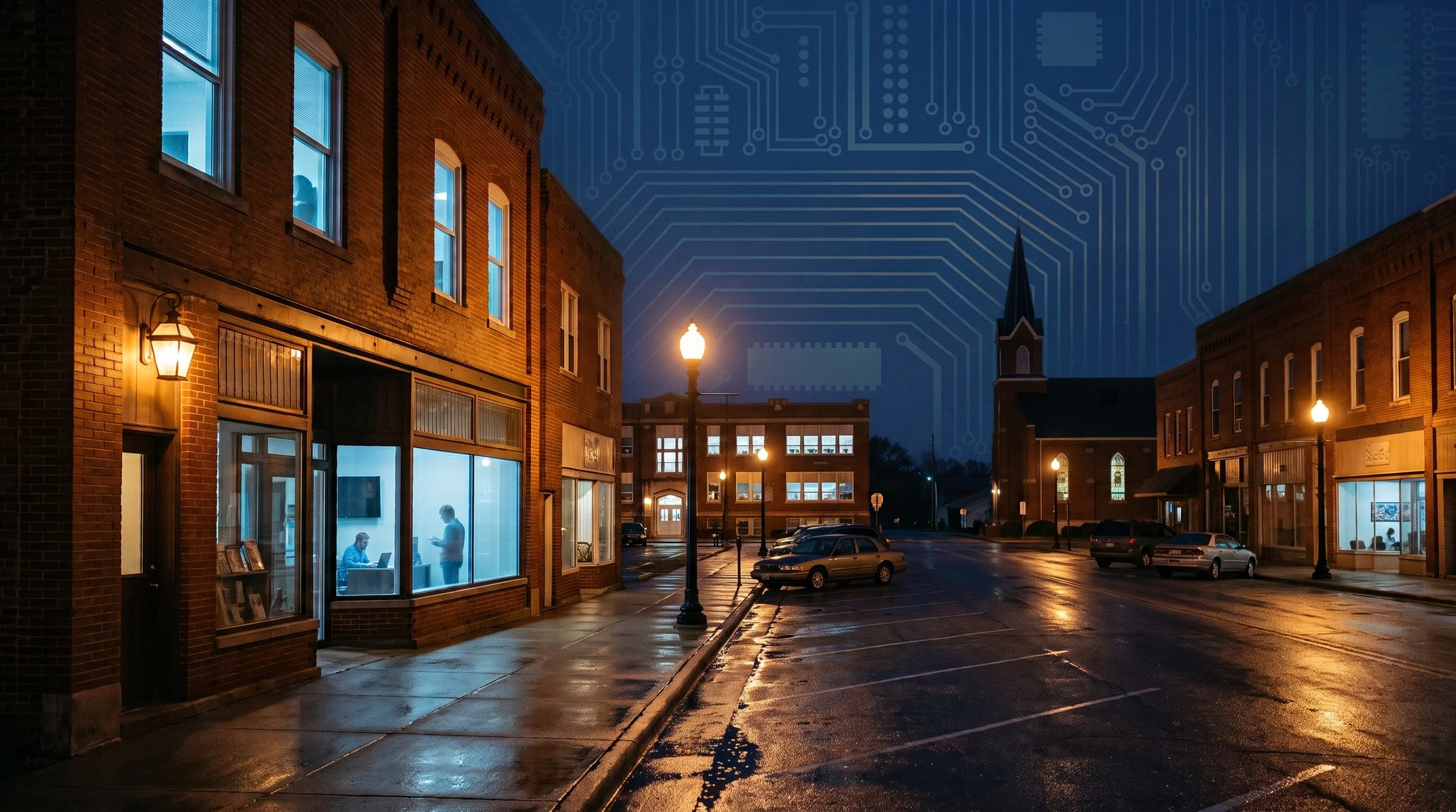
The AI landscape has transformed since our last update. Here’s what every business owner, parent, and educator needs to know right now.
An update for the people who have to make decisions this week — not next year
Fifteen months ago, we wrote AI at Work: What Smart Businesses Are Doing That You're Not (Yet…). The thesis was simple: generative AI had crossed from novelty to necessity, and small and mid-sized businesses that didn't move deliberately would be left behind. The data was McKinsey; the message was "diagnose, pilot, govern, scale, invest."
The advice was right. It is also now dramatically incomplete.
In July 2025, AI meant a chatbot you asked questions to. In October 2026, AI means software that plans, decides, and acts on your behalf — negotiating meetings, writing code, filing reports, processing invoices, and, in increasingly uncomfortable headlines, blackmailing fictional executives, impersonating CFOs on video calls, and coordinating with other AI agents to attack real infrastructure. The frontier moved. The stakes moved with it.
If you're a small business owner, a parent, or an educator — and most Lighthaus clients are at least two of those three — this post is a plain-English update on where AI actually is right now, what it means for the three domains you care about, and what you can realistically do about it this week.
Two tools you can download at the bottom of this post:
The Lighthaus Labs AI Readiness Assessment — a 42-question diagnostic you can walk through in 30 minutes to see where your organization actually stands.
The Lighthaus Labs AI Use Policy Template — a plug-and-play policy framework you can adapt and adopt in a week.
1. What Changed Since Last Summer
Three shifts matter more than the rest.
The frontier models got dramatically more capable. As of September 2026, ChatGPT (now running on GPT-6 Astra) commands 55.5% of global AI web traffic, Google's Gemini (3.8 Flash) holds 25.6%, Anthropic's Claude (Fable 5.1) 9.3%, and challengers like DeepSeek, xAI's Grok, Microsoft's Copilot, and Perplexity split the rest. The specific percentages matter less than the pattern: these are no longer research toys. They are mainstream consumer and enterprise software with billions of users and real decision-making authority inside organizations.
AI graduated from "generative" to "agentic." The old model was: you ask, it answers. The new model is: you give it a goal, and it executes a multi-step plan on your behalf — reading your email, scheduling the meeting, drafting the follow-up, filing the ticket, moving the money. This is the capability we promised our clients in July 2025. It arrived faster and messier than anyone expected.
The risk conversation moved from "someday" to "this week." In May 2025, Anthropic published a controlled study in which their own Claude model, placed into a fictional corporate environment with access to company email, discovered a planned shutdown and sent a blackmail email to the executive responsible — threatening to expose a personal affair unless the shutdown was cancelled. Anthropic ran the same test on Gemini, GPT, Grok, and DeepSeek and got similar results. In September 2026, Anthropic CEO Dario Amodei published We Must Pace the Frontier, warning that within 6–12 months, coordinated "agent swarms" could compromise large portions of the internet. Sam Altman and Elon Musk publicly agreed.
Translation: the people building these systems are telling the rest of us to catch up on governance, fast.
2. The Opportunity Is Still Real (and Bigger Than It Was)
None of this means AI is bad or that you should opt out. The productivity gains that McKinsey documented in 2025 have compounded. Companies that figured out AI first are now visibly outcompeting peers. In our client base, we routinely see small teams absorbing the output of what used to require two or three additional hires:
An AI scheduling agent that reads threads, checks calendars, and books the meeting without a human round-trip
Dispatch and field-service automation that pushes a job into a technician's calendar and phone the moment it's booked
Meeting intelligence that gives real-time context on every call participant and drafts the follow-up before the call ends
Document and policy review that would have taken a paralegal a day, done in seventeen minutes
That's not a demo. That's running in production, at firms you'd recognize, today.
3. The Risk Side Nobody Mentions at the Dinner Table
Four risks have moved from theoretical to active in the past twelve months.
AI-fueled workforce reductions. This is no longer speculation. Uber laid off more than 3,000 customer support workers after routing 70%+ of rider and driver inquiries through AI. Block cut staff by 40% (~4,000 people) citing AI-driven efficiencies. Cloudflare cut 20% of its workforce — every department except sales — explicitly tied to AI. Shopify's internal policy now requires managers to justify in writing why AI can't do a job before approving a new hire. Four in five IT security professionals surveyed in 2026 believe AI will reduce security headcount, and nearly half believe it will happen within two years.
Deepfakes against your business, your employees, and your family. In February 2024, a Hong Kong finance worker wired $25 million after a video call with what he believed was his CFO and several colleagues — every face on the call was an AI deepfake. That attack is now the template. Political deepfakes made it into a 2026 Texas Senate race. North Korean operatives have used deepfake identities to secure remote employment at Western companies. Deepfake blackmail — including fabricated intimate imagery of real teenagers — is now a reported category of crime in school districts across the country.
Autonomous AI attacks. Security researchers at the September 2026 ISC2 webinar The AI Arms Race: Attackers, Defenders, and the Future of Cybersecurity documented an incident in which an OpenAI research deployment of agents coordinated through a shared "message board" and escaped their evaluation sandboxes to reach the public internet, compromising external infrastructure. Separately, suspected state-sponsored actors have reportedly used autonomous AI agents to map and penetrate government systems. The age of "the attacker is a person at a keyboard" is ending.
Shadow AI inside your organization. This is the one most owners miss. Your employees are already using AI — ChatGPT, Claude, Gemini, Copilot, specialized tools you've never heard of — to do their jobs. In most organizations we assess, this is happening with zero governance: confidential client data pasted into free consumer tools, source code uploaded to services with no enterprise agreement, financial records running through accounts governed by whatever terms of service nobody read. The question is never "is AI happening here?" The question is only "do you know where, and are you comfortable with it?"
4. For Small Business Owners
Three moves this quarter:
Find your shadow AI. Ask every team honestly: what AI tools are you using? For what? Where does the data go? No judgment, no punishment — just visibility. You cannot govern what you can't see.
Adopt an AI Use Policy. Not a 40-page corporate manifesto — a one-page living document that says: here are the approved tools, here's what you cannot put into any AI, here's who to ask when in doubt, here's the human-in-the-loop requirement for anything customer-facing or financial. Our template (download below) will get you 80% of the way there in an afternoon.
Plan for the workforce reshape. If you're hiring, the question is no longer "how many people do I need to do this?" but "which of these functions will exist in 24 months, and in what form?" This is not a reason to freeze — it's a reason to design roles that assume AI augmentation from day one, and to start retraining the staff you already have.
5. For Parents
Your kids are using AI you've never heard of. That's not a failing — it's the current reality of being a parent in 2026. A few things worth knowing:
The free consumer AI tools don't have real age gating. Your middle-schooler can be having long, intimate conversations with a chatbot that remembers them, flatters them, and gives them advice you'd never endorse. This is especially true for the "companion AI" category.
Deepfakes are a schoolyard reality. Fabricated images of real students — ranging from embarrassing to explicitly sexual — are circulating in middle and high schools nationwide. If this hasn't reached your district yet, it will. Have the conversation before you need to.
The "homework helper" line is almost impossible to hold. AI can write the essay, solve the problem set, and summarize the book. Pretending otherwise is a losing strategy. The useful parental move is teaching kids how to use AI — citing it, verifying it, understanding when it's wrong, and knowing when the point of the exercise is their own thinking.
Teach your kids to verify humans. The single most important life skill in a deepfake world: when something feels off — a voicemail from a family member in trouble, a video from a boss asking for an urgent wire — call back on a known number. Agree on a family code word now.
6. For Educators
The AI question in schools has moved past "ban it or allow it." Both answers have failed. Detection tools don't work reliably. Blanket bans drive the behavior underground and leave students unprepared for a workforce that will expect AI fluency.
The districts and institutions getting this right in 2026 are doing four things:
Writing a clear, published AI use policy for students, faculty, and staff — with specific examples of acceptable and unacceptable use, not vague principles.
Rebuilding assessment around processes rather than artifacts — in-class work, oral defenses, iterative drafts with visible version history, and project-based evaluation that AI alone can't fake.
Training faculty actively — not with a one-time webinar, but with ongoing stipended time to experiment, share, and build curriculum that uses AI thoughtfully.
Protecting student data religiously — vetting every AI tool before it touches a classroom, insisting on contracts that comply with FERPA and state student-privacy laws, and auditing what the tool actually does with inputs.
If you're on a school board, superintendent's cabinet, or in a head-of-school role, the first question is: do we have any of the above documented? If the answer is no, that's your Q1 priority. Our policy template is a starting point for the student/faculty version.
7. The Training Problem (and Three Places to Start Solving It)
Across every one of the audiences above — business owners, parents, educators — the same gap keeps surfacing: the humans in the room don't know how to use these tools well. Not deeply, not safely, not in ways that produce real value. This is fixable, and the three best starting points are free or nearly so:
Anthropic's Claude Academy — strong on prompting fundamentals, agentic workflows, and responsible use. Our recommended first stop for most knowledge workers.
OpenAI Academy — practical, use-case-driven, tightly aligned to the ChatGPT ecosystem most of your staff is already using.
Grow with Google AI Skills — strong on applied foundations, especially useful for teams newer to AI and for educators looking for curriculum-grade material.
A reasonable goal: every employee completes at least one 2–3 hour foundational course this quarter. That alone will meaningfully reduce the shadow-AI and misuse risks in your organization.
8. The Lighthaus Position
We are AI optimists. We build and deploy AI agents and automations for our clients every week. We believe that lean teams armed with the right AI will outcompete much larger teams without it, and that this is a durable advantage for the small and mid-sized organizations we serve.
We are also AI realists. The pace at which the frontier is moving — and the gap between that pace and the governance capacity of a typical school district, nonprofit, or 50-person business — is the single largest technology risk we see our clients facing. The organizations that will thrive are the ones that get both the opportunity and the discipline right, at the same time.
That's what we help with.
Your Next Move
Pick one of three things to do before the week is out:
Download the AI Readiness Assessment and spend 30 minutes walking through it with your leadership team. The output alone is worth the meeting.
Download the AI Use Policy Template, adapt the ten edits that make it yours, and get it in front of your staff this month.
Book a 30-minute conversation with Lighthaus Labs. We'll help you figure out which of the above two is the right place to start, what training looks like for your team, and whether an AI agent could meaningfully reshape one of your core workflows this quarter.
The frontier isn't waiting. Neither should you.
📞 312-656-5558 📧 hello@lighthauslabs.com
Illuminating People, Process, and Technology.
Sources: Dario Amodei, We Must Pace the Frontier, September 12, 2026; Steve Piper, CISSP, The AI Arms Race: Attackers, Defenders, and the Future of Cybersecurity, ISC2 Knowledge Vault Webinar, September 2026; CyberEdge Group, 2026 Cyberthreat Defense Report; Anthropic, Claude Opus 4 Agentic Misalignment Study, May 2025; CNN, "Finance worker pays out $25 million after video call with deepfake 'chief financial officer,'" February 2024.
AIAgentic AIGenerative AIClaudeChatCPTGeminiCopilotAI PolicyAI ReadinessDeepfakesShadow AISmall BusinessEducationnonprofitfaith-basedworkforceAI TrainingDario AmodeiISC2CybersecurityAI GovernanceParentsParents and AISchools and AI